Maintaining a 48-volt golf cart battery system helps extend battery life, prevent sulfation, and reduce the risk of unexpected downtime. The right maintainer keeps batteries at their float voltage during storage and light use, without overcharging. Below is a curated guide and five top-maintainer choices designed for 48-volt golf carts and compatible lead-acid batteries.
| Product | Output | Charge Rate | Notes |
|---|---|---|---|
| Schauer 48V Golf Cart Battery Maintainer | 48VDC | 2.5A | Exclusively for 48V golf carts; automatic maintenance with safety protections |
| 48 Volt 1.5 Amp Clip SLA Battery Charger | 48V | 1.5A | Trickle charging for SLA 48V packs; clip connectors |
| JAC0348MAN Schauer Maintainer | 48VDC | 2.5A | Fully automatic; compatible with multiple lead-acid chemistries |
| Schauer Charge Master 3 Amps | 48V | 3A | Automatic float/maintenance mode; safe for extended connection |
| 15 AMP 48 Volt Golf Cart Battery Charger | 48V | — | Higher amperage charger; suitable for 48V lead-acid packs |
Schauer 48V Golf Cart Maintainer
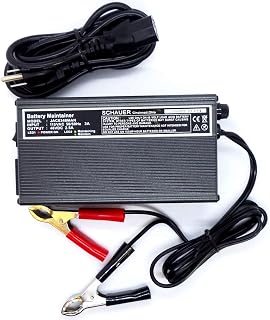
Designed specifically for 48-volt golf carts, this maintainer keeps batteries at a safe float voltage and prevents natural discharge during storage. It features fully automatic maintenance mode, allowing continuous connection without risk of overcharging. Built-in reverse polarity and short circuit protection protect the system and prolong battery life. Ideal for garages and storage sheds where carts sit idle for extended periods.
48 Volt 1.5 Amp Clip SLA Battery Charger

This 48-volt, 1.5-amp trickle charger is suitable for sealed lead-acid batteries arranged as 48V (four in series). The unit provides a simple clip connector setup and is appropriate for smaller storage cycles or light maintenance when a full charger is not needed. It is important to verify compatibility with your specific SLA battery configuration before use.
JAC0348MAN Schauer Maintainer
Schauer’s 48-volt maintainer supports automatic float/maintenance operation and includes reverse polarity and short-circuit protection. It can be used with a variety of lead-acid batteries, including conventional, maintenance-free, deep-cycle, gel, AGM, and valve-regulated types. This versatility helps in mixed-fleet environments or when multiple cart configurations are present.
Schauer Charge Master 3 Amps
The Charge Master delivers 3 amps of maintenance power for 48-volt golf carts. It operates in fully automatic maintenance/float mode and includes safeguards such as reverse polarity and short-circuit protection. Compatible with various lead-acid chemistries, it is suitable for carts that require reliable, continued maintenance without manual monitoring.
15 AMP 48 Volt Golf Cart Battery Charger

This higher-amperage charger is designed for 48-volt lead-acid battery packs and is compatible with common golf cart configurations. While providing faster charging than trickle options, it still emphasizes protection features and proper voltage control to minimize battery stress and extend life. Suitable for carts that see more frequent use or heavier loads.
Buying Guide: Key Considerations For 48V Golf Cart Battery Maintainers
Choosing the right 48-volt maintainer involves weighing how the cart is used, the battery chemistry, and how often the unit will remain connected. Here are essential factors and practical comparisons to help you decide what fits best.
- Voltage compatibility: Ensure the maintainer is explicitly designed for 48V golf cart systems. Using a device built for different voltages can damage batteries and electrical components.
- Charge mode and automation: Look for fully automatic maintenance or float mode. This enables safe long-term connection, reducing the risk of overcharging during storage or minimal usage.
- Battery chemistry compatibility: Many maintainers work with various lead-acid chemistries (conventional, AGM, gel, VRLA). If you use multiple types, choose a versatile model.
- Safety features: Reverse polarity protection, short-circuit protection, and proper isolation are critical. These features protect both the charger and the battery bank.
- Amperage and timing: Higher amperage (e.g., 3A or 15A) charges faster but generates more heat. For storage or light use, lower amperage models suffice and reduce wear.
- Connector types and accessibility: Clip connectors or clamp interfaces should suit your maintenance routine and storage setup. Ensure secure connections to avoid intermittent charging.
- Installation and space: Consider the physical footprint and whether mounting or wall-hanging is practical in your garage or shed.
- Warranty and support: A solid warranty and accessible support help address issues without interrupting cart use.
- Long-term maintenance needs: If the cart sits idle for months, prioritize a maintainer with reliable float mode and protections to prevent self-discharge and sulfation.