For golf cart owners seeking reliable 8-volt power, choosing the right 170Ah deep-cycle battery is essential. This guide highlights top options designed for golf carts, RVs, solar setups, and other demanding applications. Each product section covers key features, compatibility, and practical considerations to help you compare performance, maintenance needs, and lifespan.
Summary of chosen products
| Product | Brand | Voltage / Capacity | BCI Group | Approx. Type |
|---|---|---|---|---|
| Banshee T875 8 Volt, 170 AH Deep Cycle Battery – 6 Pack | Trojan Battery Company | 8V / 170Ah | GC8 | Flooded Lead-Acid |
| Rocket L-875 170Ah 8V Golf Cart Battery – Set of 6 | Rocket | 8V / 170Ah | GC8 | Deep-Cycle |
| US8VGC 8V 170Ah Deep Cycle Battery – 6 Pack | U.S. Battery | 8V / 170Ah | GC8 | Flooded Lead-Acid |
| (Set of 6) Pacer P-875 8V 165Ah | Pacer Battery Company | 8V / 165Ah | GC8 | Deep-Cycle |
| Mighty Max ML170-8GC – 8V 170Ah Dual Terminal | Mighty Max Battery | 8V / 170Ah | GC8 | Sealed Lead Acid / AGM |
Banshee T875 8V 170Ah Deep Cycle Battery – Trojan T-875

The Trojan Model T-875 is a 170Ah deep-cycle flooded/wet lead-acid battery in the GC8 size. Widely used in golf carts, RVs, and renewable energy systems, it supports steady, long-duration power. Typical maintenance includes water level checks and terminal cleanliness. This set is commonly used in multi-battery configurations for extended run times in demanding cycles.
Rocket L-875 170Ah 8V Golf Cart Battery
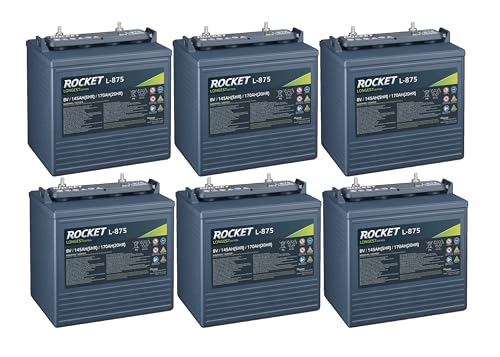
The Rocket L-875 offers 8V at 170Ah capacity, designed to replace Trojan T-875 in compatible golf cart configurations. It serves as a drop-in option for teams upgrading older cells or building longer-lasting power packs. Consider cycle life and warranty terms when planning long-term use in heavy-duty environments.
US8VGC 8V 170Ah Deep Cycle Battery – 6 Pack

From U.S. Battery, this 6-pack 8V 170Ah GC8 deep-cycle solution is suitable for golf carts, solar setups, and marine applications. It emphasizes practical replacement compatibility with T-875 and related GC8 configurations. As with flooded batteries, ensure proper venting, water maintenance, and ventilation in enclosed spaces.
Pacer P-875 8V 165Ah Deep Cycle Battery

The Pacer P-875 delivers 8V at 165Ah, compatible with GC8 configurations and often used in solar, marine, and industrial deployments as a lighter alternative to higher-capacity options. It balances energy density with cost considerations and is suitable for upgrades or replacements in older carts demanding steady discharge.
Mighty Max ML170-8GC Dual Terminal 8V 170Ah

The Mighty Max ML170-8GC is a dual-terminal, 8V 170Ah sealed lead-acid (SLA) rechargeable battery. It is maintenance-free and designed for golf carts and other deep-cycle applications. Its AGM variant provides spill resistance and smoother performance in varied temperatures, with convenient terminal options for wiring versatility.
Buying Guide: Key considerations for 8V golf cart batteries
- Battery type and maintenance: Flooded vs. sealed (AGM/SLA). Flooded batteries typically require electrolyte checks and venting, while AGM offers maintenance-free operation and better spill resistance but may have higher upfront cost.
- Capacity and depth of discharge: 170Ah is common for long run times. Evaluate your cart’s load, terrain, and daily mileage to determine appropriate Ah and a cycle life target.
- BCI group size and compatibility: Ensure GC8 compatibility with your cart’s battery rack, terminals, and interconnects. Mismatched dimensions or terminal types can require adapters or mounting changes.
- Physical dimensions and weight: Confirm length, width, and height, plus weight, to ensure fit and handling during replacement or upgrades.
- Durability and warranty: Look for manufacturers offering multi-year warranties or replacement policies in case of early degradation or defects.
- Chemistry and safety: AGM variants provide low maintenance and better spill resistance; flooded batteries require ventilation and careful handling of electrolyte.
- Lifecycle costs: Consider replacement frequency, charging regime, and compatibility with existing chargers to estimate total cost of ownership.
- Temperature tolerance: Extreme temperatures affect capacity and cycle life. If your usage is outdoors, assess the battery’s performance in heat and cold.
- Charging compatibility: Check your charger’s voltage, current output, and charging profile to ensure optimal charging for eight-volt packs.
- Environmental and disposal considerations: Battery recycling options and local regulations can impact the overall sustainability of your upgrade.