Answering your search for durable, commercial-grade golf mats, this guide highlights five top options suited for serious practice spaces. The best picks are ideal for dedicated home bays, garages, or driving ranges where long-term wear resistance matters. Choose mats with thick turf, high-density backing, and strong shock absorption for comfortable, joint-friendly sessions. The table below briefly compares the five recommended mats by size, thickness, and key features.
| Product | |||
|---|---|---|---|
| GoSports Elite 5×5 | 5′ x 5′ | 15 mm | |
| Bltend 36mm Thick 5×4 | 5′ x 4′ | 36 mm | |
| Ponsonbay 5’x4′ | 5′ x 4′ | 1.02 in (≈25.9 mm) | |
| Pro Golf Hitting Mat 4’x5′ | 4′ x 5′ | 2″ (≈50.8 mm) | |
| GoSports Elite 5×4 | 5′ x 4′ | 15 mm |
GoSports Elite 5×5 Golf Hitting Mat

Best for frequent, serious practice in a dedicated space. The mat uses commercial-grade synthetic turf for a real-feel fairway response and a durable EVA foam base that absorbs shock and reduces joint strain. The non-slip backing helps keep the mat stable on concrete or turf, making it suitable for both indoor bays and outdoor patios. Selected for golfers who need reliable consistency across hundreds of swings.
Who it’s best for: high-volume hitters, home setups that double as mini driving ranges, and trainees who value long-lasting turf feedback. Limitation: heavier mats require more space and can be cumbersome to move when needed.
Bltend 36mm Thick Golf Mat 5×4

Best for maximum cushioning and all-weather use. This mat combines a 16mm dense turf with a 20mm high-elasticity EVA pad to absorb over 90% of ground impact, protecting joints and clubs. It is designed for commercial-grade durability with reinforced edges and an anti-tearing layer, making it a strong choice for year-round practice on concrete, grass, or simulators.
Who it’s best for: players needing a forgiving surface for long practice sessions. Limitation: the thicker construction makes it bulkier and less portable than thinner mats.
Ponsonbay Integrated Golf Hitting Mat

Best for convenience and portability. This 5’x4′ mat features a built-in ball tray, reducing gear clutter, and a single-piece design that rolls up for transport. The turf is upgraded to a thicker 0.63 inches to improve impact resistance, while the EVA base provides stability and joint protection. Selected for players who want a compact practice setup with fewer accessories to manage.
Who it’s best for: home golfers with limited space who still want a sturdy, integrated practice solution. Caution: integrated tray adds weight and may limit surface flexibility in very tight spaces.
Pro Golf Hitting Mat 4’x5′

Best for heavy-duty training and simulator setups. This mat uses a 1 3/8″ nylon turf with a 5/8″ NBR foam base to deliver a realistic fairway feel and strong cushioning. It’s engineered to withstand up to 500,000 shots without fraying, offering long-term value for serious golfers practicing indoors, outdoors, or in simulators.
Who it’s best for: players who swing hard and need a rugged surface. Limitation: higher-density nylon tends to be firmer than some all-poly materials, which may feel stiffer to very new players.
GoSports Elite 5×4 Golf Hitting Mat
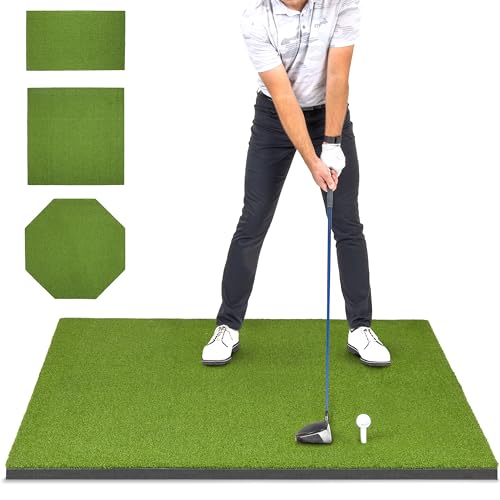
Best for space-efficient practice with credible turf feel. This mat mirrors real fairway grass with a durable commercial-grade surface and EVA foam base for shock absorption. The non-slip backing ensures stability on various floors, making it a reliable choice for compact indoor setups and smaller outdoor areas.
Who it’s best for: golfers seeking a balance of size, feel, and stability in limited spaces. Limitation: the 5×4 size may be too small for some full-swing practice needs.
Buying Guide
What thickness matters for you?
Thicker mats (30 mm and above) provide superior cushioning and joint protection but are heavier and harder to move. Thinner mats (15–20 mm) are lighter and easier to manage but offer less impact absorption. For high-volume or long sessions, prioritize thickness and padding.
How does turf density affect feel?
Dense artificial turf recreates a realistic fairway feel and reduces ball-hop inconsistencies. Look for high-density fibers and UV-resistant construction for all-weather use and longer life.
Durability and edge design
Commercial-grade mats use reinforced edges and anti-tearing layers to withstand repeated impacts. Durable bases ( EVA or NBR foam) improve stability and reduce club wear on hard surfaces.
Integrated features worth considering
Ball trays, non-slip backs, and built-in tees add convenience. Consider whether you prefer a portable, one-piece design or a larger, more spacious mat for full swings.
Indoor vs outdoor use
All-weather mats with UV-resistant turf are better for outdoor garages or patios. Indoors, ensure the mat has a stable backing and does not damage floors. Portability may be a factor if you rotate practice spaces.
Which mat is right for you?
For frequent, long sessions in a fixed space, choose the thicker, denser mats with reinforced edges. If you want a portable setup with built-in trays, look at integrated tray models. For budget-conscious shoppers, balance durability with a reasonable thickness and turf density.
FAQ
- What thickness should a commercial-grade golf mat have? Generally, 15–36 mm works well. Higher thickness improves shock absorption and joint protection, especially for repeated swings.
- Are integrated ball trays worth it? Yes if you value space-saving design and quick access to balls during practice.
- Is UV resistance important for outdoor use? Yes, UV-resistant turf extends life when mats are left outside or in bright sun.
- Can I use these mats with real tees? Most premium mats support real tees, but verify the recommended tee height and compatibility in the product specs.
- Which mat is best for a home garage setup? Mats with a stable non-slip back and moderate thickness (15–25 mm) strike a balance between feel and portability.
- Do thicker mats affect ball flight or swing dynamics? Mats mainly affect feel and cushioning; flight is primarily influenced by club, swing mechanics, and strike quality.