Hinged golf club trainers guide your arms and wrists through a repeatable swing, helping you build muscled memory and consistent timing. The five devices featured here use dual hinges, hinge-like mechanisms, or hinge-inspired designs to improve swing path, tempo, and accuracy. The quick table below highlights each option’s core benefit to help you compare at a glance.
| Product | Brand | Key Benefit |
|---|---|---|
| Medicus Dual Hinge Swing Trainer | Medicus | Dual hinge guidance for full swing |
| Medicus 2000 Dual Hinge 5 Iron | Medicus | Instant feedback for iron play |
| ForeNoMore Lag Shot | ForeNoMore | Real-time swing fault feedback |
| KISEER Hinged Swing Trainer (2 Pack) | KISEER | Posture and hinge correction |
| The ONE Club Swing Trainer | ONE Dynamic Inertia | Progressive inertial resistance |
Medicus Dual Hinge Swing Trainer

The Medicus Dual Hinge Swing Trainer combines a driver and a putter with synchronized hinge points to guide your arms through a natural arc. The dual-hinge design helps you feel the correct path, reducing common flaws and promoting a consistent clubface throughout the swing. By constraining motion at two joints, it encourages a repeatable sequence essential for rhythm and tempo. The setup is designed to be intuitive, so beginners can recognize the intended motion early in their practice.
During practice, you can hit live balls to translate the drills to on-course performance. The unit emphasizes tempo and plane, with nine primary breakpoints indicating probable flaws, which helps you diagnose issues like over-the-top paths or early extension. This makes it a versatile option for players seeking fundamentals as well as experienced athletes aiming to refine consistency across full-swing shots.
Medicus 2000 Dual Hinge 5 Iron

The Medicus 2000 Dual Hinge 5 Iron targets iron play with a focused hinge design. Its dual hinges guide the back swing and through swing, encouraging a repeatable, coach-like sequence that mirrors real-world golf motion. This iron-specific trainer is well suited for home setups or practice-range sessions where you want to build a dependable iron swing without complex adjustments.
Instant feedback is a core feature, helping you feel the proper timing, tempo, and coordination. Regular use is associated with improved ball striking and distance control as the body learns to synchronize hips, torso, arms, and wrists in a stable arc. Its compact form makes it practical for at-home studios or small practice areas, without sacrificing effectiveness on the range.
ForeNoMore Lag Shot Golf Training Aid
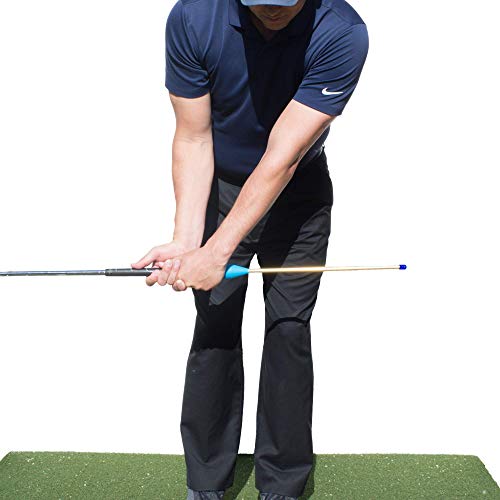
The ForeNoMore Lag Shot Lag Stick provides instant feedback on swing faults by attaching to grip areas and offering real-time data on path and rotation. The device emphasizes rotation and wrist hinge, helping you avoid flipping and misalignment through a simple, high-visibility shaft that makes it easy to see whether your swing follows the proper arc. The lightweight cue system nudges you toward the correct path, supporting quick adjustments during practice.
Designed for a wide range of players—from beginners to advanced—the Lag Shot fits most irons and includes a drill-oriented approach that mirrors tour-like chipping fundamentals. Practitioners can visualize flaws and feel the corrections, enabling faster transfer from practice to course performance. It’s an effective tool for developing consistent contact and a more reliable chipping technique.
KISEER Hinged Swing Trainer (2 Pack)

The KISEER Hinged Swing Trainer comes as a two-pack that you position on the club and secure against the arm. The hinge setup promotes the correct back-swing posture and alignment, encouraging a smoother transition and a more repeatable sequence. This dual-pack provides flexibility for practice with different clubs or for a partner drill, making it a practical option for households or training groups.
By focusing on back-swing form, the tool helps reduce wasted power and facilitates better energy transfer into the downswing. Regular, deliberate use can improve posture, alignment, and clubface control, which translates to more consistent contact and longer, straighter shots. Its portable design makes it easy to take to the driving range or use in a compact home space.
The ONE Club Swing Trainer

The ONE Club Swing Trainer uses patented progressive inertial resistance tied to swing speed. The faster you swing, the more resistance you encounter, encouraging the athlete to develop greater speed, consistency, and confidence. This inertial approach helps you explore your kinetic potential and understand how to accelerate through impact without losing control of timing.
In addition to resistance, ONE provides tactile and audible cues that aid release and timing. The device is designed to adapt to a variety of swing styles and strength levels, helping players refine their kinematic sequence and achieve cleaner contact. By motivating players to refine technique while matching effort to speed, it supports measurable improvements in distance and accuracy over time.
Buying Guide
When choosing a hinged golf club trainer, consider how you plan to practice, your current skill level, and the type of feedback you prefer. Hinged devices guide motion, while inertial trainers add resistance to develop speed and strength. Here are key purchase considerations and practical comparisons across the five highlighted options.
- Training goal and mechanism: If you want strict guidance for swing path and posture, hinge-based trainers like Medicus and KISEER are strong choices. If you aim to develop power and speed with feedback, consider the progressive resistance approach of The ONE Club.
- Club compatibility and setup: Some trainers are iron-specific or include driver/putter combinations, while others work across multiple clubs. Check how easily the device attaches, whether adjustments are needed, and whether it suits your primary practice clubs.
- Feedback style: Instant feel-based feedback helps you sense correct mechanics, whereas visual or data-driven cues (as with Lag Shot) assist with real-time path verification. Consider which style translates best for your learning pace.
- Practice environment: For home use, compact, portable units are ideal. If you frequently practice at the range, look for durability and ease of setup for quick sessions between rounds.
- Durability and warranty: A robust hinge mechanism and high-quality materials are important for long-term use. Review warranty terms and customer service access when evaluating price/value.
- Skill progression: Beginners may benefit from devices with clear, guided motions, while advanced players might prefer trainers offering more nuanced feedback or adjustable resistance to challenge their current swing.
- Safety and progression: Start with light use and gradually increase range of motion and intensity. Follow manufacturer guidelines to minimize strain or injury during practice sessions.
In summation, hinge-based trainers are strongest for building foundational mechanics—path, plane, and tempo—while inertial trainers excel at developing speed and release timing. The best choice depends on your current swing pattern, the club types you use most, and how you prefer to learn. For a comprehensive improvement plan, consider pairing a hinge-focused device with an inertial trainer to address both mechanics and power development over time.