Indoor golf impact screens let you practice with real balls and project immersive simulations right in your garage, basement, or dedicated practice bay. The best options resist heavy ball impacts, minimize bounce and noise, and fit a range of spaces from tight garages to spacious rooms. When choosing, consider screen thickness and material, grommet density, frame stability, and projector compatibility. Below are five top-rated screens and cages that balance durability, size, and value for American homes and home studios.
The table below summarizes the chosen products to help you compare key specs at a glance.
| Product | Brand | Size | Key Benefit |
|---|---|---|---|
| GoSports 9 ft Golf Simulator Impact Screen | GoSports | 108 x 82.5 in | Durable, universal mounting; compatible with real balls |
| GoSports Range Cage 10 ft x 8 ft | GoSports | 88 x 80 in impact screen | Built-in shank nets; sturdy cage with premium screen |
| amazgolf Golf Simulator Impact Screen | amazgolf | 118×78 / 118×118 / 118×157 in | Multiple sizes; washable; clear projection |
| ZEALFEEL Golf Simulator Cage + Screen | ZEALFEEL | 10 ft x 8 ft (screen 91×86 in) | Dual-layer HD screen; strong frame and stability |
| Durbles Golf Simulator Impact Screen | Durbles | varies by kit | Premium triple-layer design; quiet and durable |
GoSports 9 ft Golf Simulator Impact Screen

The GoSports 9 ft Golf Simulator Impact Screen is designed as a large, durable backdrop for home golf setups. Measuring 108 by 82.5 inches, the screen provides ample projection area for most 1080p or higher projectors and pairs well with the GoSports ELITE Golf Net for a complete simulator bay. The screen is constructed from high-density woven polyester, delivering resilience against repeated ball impact while retaining a clear projection surface. It offers universal mounting thanks to four grommets at each corner and can be hung independently or connected to the ELITE net for a seamless, space-saving configuration.
With real-ball compatibility in mind, the GoSports screen is built to handle diverse practice shots without excessive rebound. The installation approach is flexible—hang it on a wall, inside a frame, or link it to compatible nets to create a fully enclosed space. The materials balance durability and visibility, making this a solid choice for dedicated practice rooms, garages, or basements where noise control is a consideration.
GoSports Range Cage 10 ft x 8 ft Golf Practice Hitting Net

The GoSports Range Cage pairs a sturdy practice cage with an 88 x 80 inch impact screen designed for use with golf simulators and projectors. The cage design includes built-in shank nets on each side and protective top netting, helping to contain mis-hits and keep your practice area tidy. The 88 x 80 inch screen is crafted from high-density woven polyester to serve as a reliable projector backdrop. The frame features a foam-lined steel base to minimize rebound and prevent balls from slipping underneath, providing stability during powerful swings. This setup is ideal for dedicated bays or garages where space is sufficient for a cage-style enclosure.
Designed to endure real-ball practice, the GoSports Range Cage emphasizes durability and risk mitigation. While launch monitors and projectors are not included, this system is well-suited to integrate with most consumer-grade projectors and monitors. The combination of a reinforced frame, protective netting, and a substantial impact screen makes it a strong option for frequent use and varied swing speeds, from leisurely practice to high-intensity sessions.
amazgolf Golf Simulator Impact Screen

The amazgolf Golf Simulator Impact Screen offers a practical solution with multiple size options, including 118 x 78 inches, 118 x 118 inches, and 118 x 157 inches. This screen is designed for indoor golf training and projection, delivering a clear visual backdrop for simulation software. Crafted from natural polyester, the fabric is described as 100% natural, resilient, and washable, supporting easy maintenance and long-term use. The screen emphasizes a balance between durability and projection accuracy, ensuring stable images while withstanding repeated impact from shots.
Proponents of this screen appreciate its versatility across different room sizes and projection setups. The washable fabric simplifies cleanup after long practice sessions, and the different size options allow you to tailor the screen to your space and projector throw. It’s positioned as a reliable option for home enthusiasts who want a straightforward, maintenance-friendly screen that still delivers a crisp, lifelike practice environment.
Aikeec Golf Simulator Impact Screen
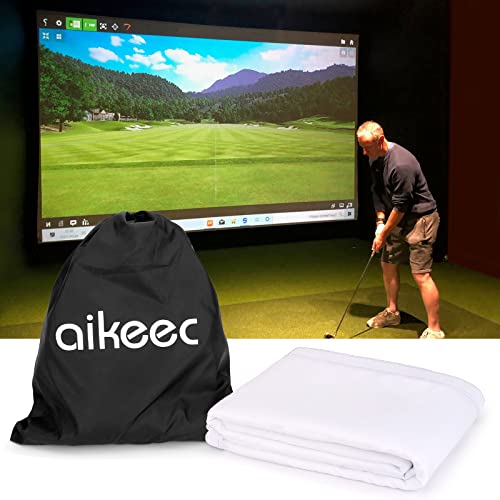
The Aikeec Golf Simulator Impact Screen features a 7mm thickened, ultra-clear design with 32 grommets around the perimeter for flexible mounting. Sized at 10 by 10 feet, this screen emphasizes durability and stability under high-speed swings, with a focus on quiet impact and minimal noise disruption. The 5mm thick polyester construction contributes to long-lasting performance, absorbing ball impact and reducing vibration. The product notes emphasize easy setup through multiple attachment options, making it suitable for home basements, garages, or outdoor setups where a quick install is desirable.
Potential buyers looking for a robust enclosure with a strong edge may find the Aikeec screen appealing due to its reinforced perimeter and durable materials. While the exact throw distance compatibility can vary by projector and room layout, the overall build quality supports repeated practice across a range of swing speeds, from beginners to mid-level players seeking consistent feedback from their simulation software.
Durbles Golf Simulator Impact Screen

The Durbles Golf Simulator Impact Screen is built around a premium triple-layer design, combining an HD outer layer, an ultra-sound damping middle layer, and an impact-resistant inner layer. This construction aims to maximize durability while minimizing sound resonance during ball impact. Marketed as a commercial-grade hitting screen, it’s described as capable of handling thousands of ball impacts and suitable for both home use and busy facilities. The anti-resonance, damping layer helps keep practice sessions quiet, making it a strong choice for shared living spaces or late-evening practice.
Designed for heavy-duty use, the triple-layer approach provides an extra margin of longevity. While installation details aren’t exhaustively specified in marketing materials, the durable construction and quiet operation suggest suitability for long-term practice in dedicated rooms or smaller studios where consistent performance and low disturbance are priorities.
Buying Guide
Space And Sizing
Choose a screen or cage that fits your room dimensions and your projector’s throw. Large screens provide expansive projection and immersive visuals but require more space and stronger mounts. Smaller screens are easier to mount in compact garages yet still deliver a realistic practice surface when paired with a suitable projector and hitting net. Consider the height and width of your ceiling, the distance to the projector, and how much room you need for a full swing without interference from walls or furniture.
Durability And Build Quality
Screen material matters. High-density polyester blends and triple-layer constructions typically offer better impact resistance and longer lifespans. Frames should be sturdy, with reinforced bases or steel components to minimize rebounding and movement during powerful swings. If you practice with real golf balls, look for tear resistance, edge reinforcement (grommets or reinforced seams), and minimal stretch over time to preserve image integrity.
Projection Compatibility
Ensure the screen surface provides a clear projection for your required brightness and resolution. Some screens emphasize clarity for high-definition simulations, while others prioritize quiet impact and reduced bounce. If you use a launch monitor or a particular simulator software, verify that the backdrop won’t distort the image and that your projector’s throw distance is appropriate for the screen size you choose.
Mounting Options And Installation
Montage flexibility matters. Some options are wall-mounted, others are cage-based with a stand, and some connect to a hitting net for a seamless, enclosed bay. Four-corner grommets enable straightforward hanging, but you may also want connectors to align with existing nets. Look for pre-punched holes, easy-tie mounting, and included hardware. If you plan to relocate, consider portability and the weight of frames and screens.
Maintenance And Longevity
Maintenance varies by fabric. Washable surfaces simplify cleaning after sweaty sessions. Note that frequent exposure to real-ball impacts can wear fabrics over time, so a durable, well-stitched screen will save replacement costs. For enclosed cages, ensure the netting and frame stay taut and supported to maintain wall-to-wall projection alignment.
Value And Use Case Comparisons
For a garage with ample floor space and a dedicated projector, a larger screen like 108 x 82 inches with a sturdy frame (GoSports 9 ft) provides a cinematic practice environment. If space is more constrained, a cage design with a tight, high-durability screen (ZEALFEEL or GoSports Range Cage) offers reliable containment and stable projection in smaller footprints. For frequent use, triple-layer or multi-layer constructions (Durbles) emphasize durability and quieter practice at the cost of higher price. Always balance cost against room size, expected use, and maintenance preferences.
In summary, pick a setup that matches your room, your projector system, and your swing tempo. A well-chosen screen not only enhances visibility but also minimizes noise and bounce, letting you practice longer with more consistent feedback from your simulator software.